Pulse Practice Solutions, Document Management, Document Scanning, EMR, Marketing & Managed IT for Medical Practices
  • News
  • Practice Solutions
    • Digital Faxing
    • Electronic Medical Records
    • Backfile Scanning Services
    • Document Management
    • Online Forms
    • EOB Data Capture and Processing
      • Automated EOB Processing Webinar
    • Managed IT Solutions
    • Telecommunications
    • Automated Appointment Reminders
  • Practice Marketing Services
    • Practice Identity Services
    • Logo Design
    • Practice Websites
    • Online Reputation and Social Media Management
    • Printing and Marketing Materials
      • Practice Stationery
      • Practice Presentation Folders
  • Partners
    • Software
    • Hardware
  • Contact Us

Why Work Flow Analysis, Redesign Are Keys to Successful EMR Implementation…and EMR Selection

Work flow analysis and future work flow redesign are often cited as key factors of successful implementations of ambulatory electronic medical records (EMRs) in physician practices.  This is the first in a series of blogs to discuss the value of performing workflow analysis before selecting an ambulatory EMR.

It is unfortunate that work flow analysis, if performed at all, is typically not done until an EMR has been selected and the implementation initiated.  Although physicians intuitively understand the value of good workflows in the office, how workflow analysis helps the physician choose an EMR is not so obvious. 

Workflow analysis can provide the physician practice insights on what to look for in their new EMR product if done early in the selection process.  To get the most out of a work flow analysis it is best to start with a clear purpose in mind.   Some important reasons for initiating work flow analysis before selecting an EMR are to:

  • Identify current office inefficiencies
  • Initiate critical thinking about desired future work flows
  • Develop a prioritized list of desired future workflows (what are the most important ways an EMR is expected to help the practice?)
  • Develop a prioritized list of the most important EMR functionalities that are needed in order to realize these desired future work flows
  • Set realistic expectations on how the EMR is expected to help achieve goals and attain better workflows 

When a work flow analysis is completed the physician practice should expect to see: 

  • Detailed descriptions of current office work flow
  • Detailed work flow maps of key office processes
  • An analysis that identifies current inefficiencies, bottlenecks and opportunities for improvements
  • A high-level outline of desired future workflow redesigns (how the office will work when a EMR is operational)
  • A list of changes that could be made now…even before selecting an EMR

A workflow analysis will initially result in written descriptions of the key processes that the physician practice thrives on each day.  These written descriptions are then synthesized into a workflow map that may look something like this:
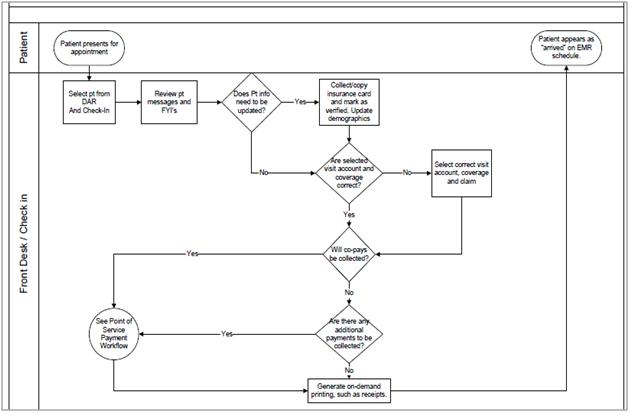
This current workflow map can be used by the practice to design better workflows.  Using the current workflow example from above, the draft development of a future workflow map might initially look something like this:
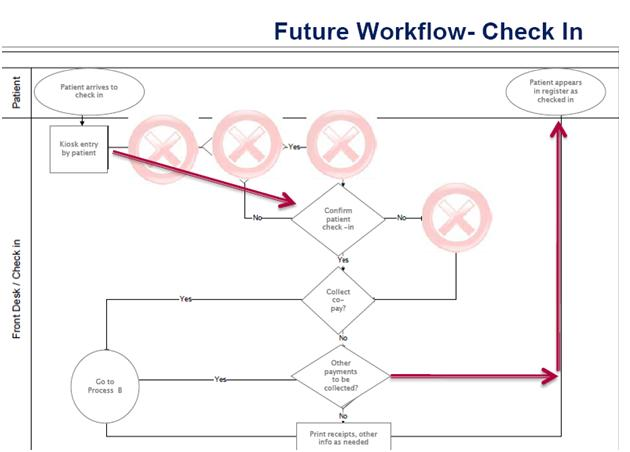
Developing workflow descriptions and critically thinking about desired future workflows will help identify what an EMR needs to be able to do well for the practice.  Knowing what the EMR needs to do well will help the practice identify and prioritize needed EMR functionalities.

Source: Digitized Medicine

Comments are closed.

Services

Follow us

Copyright 2015 - Pulse Practice Solutions | 615.425.2719

  • Go to top ↑